Brachy grids play a critical role in modern prostate procedures by helping clinicians place needles with exceptional accuracy during prostate brachytherapy and transperineal prostate biopsy. Used alongside an ultrasound probe and stepper stabiliser, a brachy grid provides a fixed coordinate system that improves precision, treatment consistency, and patient safety.
On this Page
What Is a Brachy Grid?
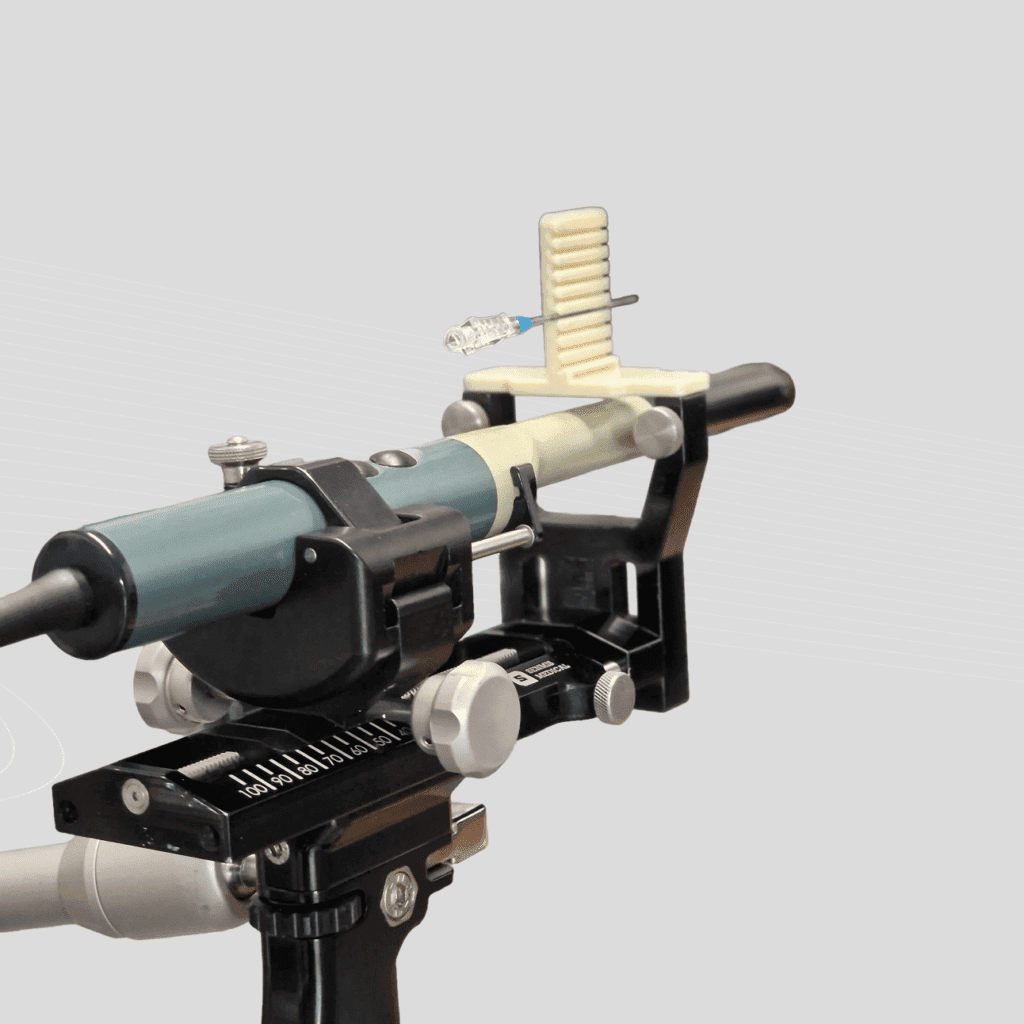
A brachy grid, also known as a template grid or perineal template, is a medical device used to guide needle placement through the perineum during prostate procedures. It is mounted onto a stepper stabiliser and aligned with the probe, creating a precise coordinate system that allows clinicians to target specific areas of the prostate.
Most brachy grids feature a matrix of evenly spaced holes, commonly 5 mm apart, although some systems use 3 mm spacing for finer targeting. Each hole is identified by a letter and number, enabling accurate documentation and repeatable needle placement.
The grid is most commonly used in:
- Low-dose rate (LDR) prostate brachytherapy
- High-dose rate (HDR) prostate brachytherapy
- Template-guided transperineal prostate biopsy
- Focal therapy procedures
- Research and image-guided prostate interventions
According to the American Association of Physicists in Medicine (AAPM) and peer-reviewed literature, template-guided needle placement has become a standard component of modern prostate brachytherapy because it improves implant accuracy and dosimetric outcomes.
What are the functions of Brachy Grid?
1. Provides Precise Needle Guidance
The primary function of brachy grid is to guide needles into the prostate with a high level of precision.
Rather than relying on freehand needle placement, clinicians insert the biopsy gun through a predefined hole in the grid. The grid acts as a physical guide, helping maintain the planned entry point while reducing unwanted movement.
This level of precision is particularly important because even a small deviation can affect seed placement or tissue sampling.
Studies published in Brachytherapy and Medical Physics have shown that template-guided procedures improve needle placement accuracy and contribute to better treatment quality.
2. Creates a Coordinate Mapping System
Every hole within the grid corresponds to a specific coordinate. During ultrasound imaging, physicians identify the target location inside the prostate and match it with the appropriate grid coordinate.
This allows every needle position to be documented accurately throughout the procedure. The coordinate system also enables:
- Consistent treatment planning
- Easy communication among the clinical team
- Accurate record keeping
- Repeatable needle placement when adjustments are required
This structured mapping is one of the reasons template-guided procedures have become widely adopted in prostate brachytherapy.
3. Improves Seed Placement During Brachytherapy
In prostate brachytherapy, radioactive seeds or temporary radiation catheters must be placed exactly where the treatment plan specifies.
The brachy grid ensures needles enter the prostate at the planned locations, helping clinicians distribute radiation evenly throughout the gland while minimising exposure to surrounding structures such as the urethra, bladder and rectum.
Accurate seed placement contributes to:
- Better tumour coverage
- Improved radiation dose distribution
- Lower risk of under-treating cancer
- Reduced radiation exposure to healthy tissue
Research published in Radiotherapy and Oncology has consistently shown that implant accuracy is a major factor influencing successful prostate brachytherapy outcomes.
Best Prostate Biopsy Kit in UK!
40+ Urologists upgraded.
4. Supports Transperineal Prostate Biopsy
Beyond brachytherapy, brachy grids are increasingly used during template-guided transperineal prostate biopsy. The grid allows systematic sampling of the prostate by guiding biopsy needles through predefined locations.
This approach offers several advantages over traditional transrectal biopsy:
- Better sampling of the anterior prostate
- More consistent biopsy mapping
- Reduced infection risk because the needle avoids the rectum
- Improved access to difficult areas of the prostate
Current European Association of Urology (EAU) guidelines recognise transperineal biopsy as an effective approach for prostate cancer diagnosis, with growing adoption worldwide.
5. Enhances Procedure Reproducibility
One of the biggest advantages of a brachy grid is consistency. Every procedure follows the same coordinate system, making results reproducible regardless of operator experience.
This standardisation is valuable for:
- Multi-centre clinical studies
- Hospital quality assurance programmes
- Physician training
- Long-term patient follow-up
Standardised needle placement also helps reduce variability between procedures.
6. Works Together with Ultrasound Imaging
The brachy grid is not used independently. It functions alongside:
- Transrectal ultrasound (TRUS)
- Stepper stabiliser
- Needle guide system
- Treatment planning software
The ultrasound provides real-time visualisation of the prostate, while the stepper maintains stable probe positioning. The brachy grid translates the ultrasound image into physical coordinates, enabling clinicians to guide needles accurately to the intended target.
This integration forms the foundation of modern image-guided prostate interventions.
7. Helps Protect Surrounding Structures
Precise needle placement reduces unnecessary trauma to surrounding tissues. By following planned needle paths, clinicians can better avoid important structures including:
- Urethra
- Bladder neck
- Neurovascular bundles
- Rectum
This contributes to safer procedures while supporting treatment accuracy.
8. Improves Workflow in the Operating Room
A brachy grid also improves procedural efficiency. On the stepper system, the grid provides a stable reference throughout the procedure. Instead of estimating needle positions repeatedly, clinicians simply select the appropriate coordinate. The benefits include:
- Faster needle positioning
- Better procedural organisation
- Improved communication among staff
- Reduced need for repeated adjustments
These workflow improvements become particularly valuable during complex HDR brachytherapy procedures involving multiple needles.
Why does hole spacing matter?
Most prostate brachy grids use 5 mm spacing, although specialised applications may use smaller intervals. The spacing has been developed through decades of clinical experience and remains a key design feature of modern template systems. Uniform spacing allows clinicians to:
- Cover the entire prostate systematically
- Maintain consistent needle distribution
- Improve treatment planning accuracy
- Reduce overlap between adjacent needle paths
Conclusion
The brachy grid is an essential component of modern image-guided prostate procedures. By providing a precise coordinate system for needle placement, it improves the accuracy of brachytherapy, supports systematic transperineal biopsy, enhances procedural consistency, and helps protect surrounding healthy tissues.
When combined with a stepper stabiliser, ultrasound imaging, and appropriate treatment planning, the brachy grid enables clinicians to perform prostate interventions with a high degree of precision. As prostate cancer diagnosis and treatment continue to evolve, the brachy grid remains a cornerstone of safe, reproducible, and effective prostate care.
FAQs
What are the functions of a brachy grid?
Its primary function is to guide needles accurately into the prostate during brachytherapy and transperineal procedures using a fixed coordinate system.
Is a brachy grid only used for prostate cancer?
No, While it is primarily associated with prostate brachytherapy, it is also used for template-guided transperineal prostate biopsy and certain focal therapy procedures.
Does the brachy grid improve accuracy?
Yes, Template-guided needle placement is widely recognised for improving procedural precision and consistency compared with freehand approaches
Why is the grid used with a stepper?
The stepper stabilises the ultrasound probe, while the grid provides the coordinate system needed for accurate needle placement.