
Overview
With real-time ultrasound imaging and a brachy grid, the procedure supports consistent access to planned biopsy targets while maintaining probe stability during the examination.
Key Components Used During the Stepper-Guided Biopsy Procedure
The Stepper-Guided Transperineal Biopsy procedure combines a precision positioning system, real-time ultrasound imaging, and specialised biopsy instruments to support accurate, systematic tissue sampling. Each component plays a specific role in maintaining probe stability, guiding needle placement, and supporting a consistent biopsy workflow.
Provides controlled linear, rotational, and vertical positioning of the ultrasound probe, allowing stable imaging and precise probe adjustments.
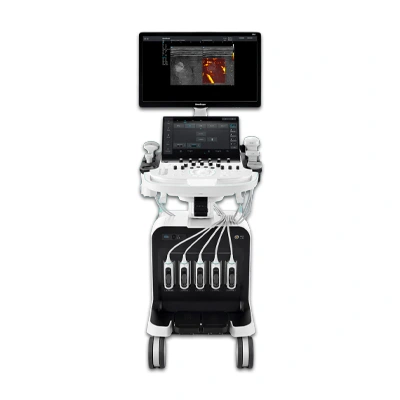
Delivers real-time sagittal and axial ultrasound views of the prostate, helping clinicians visualise anatomy and guide needle placement during the biopsy.
A precision-guided template that provides coordinate-based needle entry points for systematic and repeatable sampling across the prostate.
Securely holds the stepper in position and helps maintain probe stability throughout the biopsy while allowing controlled repositioning when required.
Key Features of the Smart Stepper Stabiliser
Provides stable positioning of the ultrasound probe throughout ultrasound-guided prostate procedures, allowing the clinician to maintain the selected probe position during scanning and tissue sampling.
Locking mechanisms help maintain probe stability during the procedure while allowing repositioning whenever required.
Features a modular construction for efficient assembly, straightforward operation, and convenient disassembly after use.
Clinical Workflow Support
Together, these components create a structured stepper-guided biopsy workflow, enabling stable ultrasound probe positioning, accurate grid-guided needle placement, systematic tissue sampling, and secure specimen handling throughout the transperineal prostate biopsy procedure.
Content extract from the existing GPS stepper-guided procedure material.
Read the published GPS article ↗

Join the conversation
Read or leave a comment on the published article.
Leave a comment ↗